

Spend enough time in the women’s health world, and you’ll hear one phrase attached to almost everything.
Balance your hormones.
Acne? Hormones.
Trouble sleeping? Hormones.
A difficult period, changes in weight, low energy, mood changes, fertility concerns? Somewhere along the way, there’s a good chance you’ve been told your hormones need to be “balanced.”
I understand why the phrase caught on. Hormones influence an enormous number of processes in the body, and they absolutely deserve more attention than women’s health has historically given them.
But “hormone balance” has become so broad that I’m not sure it tells us much anymore.
Hormones can give us valuable information, but they are one part of a much bigger picture. Symptoms aren’t always explained entirely by hormones, and hormonal changes themselves can reflect what is happening elsewhere in the body.
The more useful question is often not simply “Are my hormones balanced?” but “What is this pattern telling us, and what else should we be looking at?”
That is the idea I want you to take away from this article.
What Does Hormone Imbalance Actually Mean?
Hormone imbalance is a broad term generally used when one or more hormones may be too high, too low, or behaving differently than expected.
The tricky part is that hormones are supposed to change.
Estrogen and progesterone fluctuate throughout the menstrual cycle. FSH and LH rise and fall as the brain and ovaries communicate. Cortisol follows a daily rhythm and responds to stress. Insulin changes in response to food and metabolic needs.
Pregnancy, postpartum, perimenopause and menopause bring their own hormonal changes. Medications, hormonal contraceptives and health conditions can affect what we expect to see as well.
There isn’t one hormonal state that represents “balance” for every woman at every stage of life.
So when a patient tells me she thinks her hormones are “off,” my next question is usually some version of “what is actually happening?”
I want to understand the symptoms, their timing, and what else may have changed around the same time. Hormones interact with metabolic health, thyroid function, stress physiology, nutrition, the gut, and many other systems. Sometimes the hormonal change is part of a larger story rather than the entire story itself.
What Can a Hormonal Problem Actually Look Like?
There isn’t one set of symptoms that automatically means you have a hormone imbalance. Often, what gets my attention is a change or a recognizable pattern.
Menstrual cycles may become irregular or disappear. Acne can suddenly worsen or consistently flare at a certain point in the cycle. Increased facial or body hair may develop. Someone may have difficulty conceiving or begin experiencing significant menstrual and physical changes as she approaches perimenopause.
Those symptoms give us somewhere to start. They don’t provide a diagnosis by themselves.
Irregular periods and acne, for example, could lead us to investigate androgen activity and PCOS (now PMOS). A missed period has a different range of possible explanations. Changes in your 40s may be related to the menopause transition.
This is why I want to know more than what you’re experiencing.
When did it begin? Has your menstrual cycle changed? Is there a pattern? Have you started or stopped a medication? What else was happening with your health when things shifted?
The answers help determine where we look next.
And this is something you can start paying attention to before you ever walk into an appointment.
Acne Is a Good Example
Calling acne a hormonal imbalance gives us a category, but it doesn’t necessarily give us an explanation.
Hormonal changes can absolutely contribute to acne, particularly when androgens increase oil production in the skin. But I still want to understand the individual pattern.
Does the acne change during the menstrual cycle? Are periods regular? Did it begin after starting or stopping hormonal contraception? Are there other signs of increased androgen activity? Is there a reason to investigate insulin resistance or PCOS/PMOS?
Or is there something else contributing to what we’re seeing on the skin?

That information is far more useful than simply deciding someone needs to “balance her hormones.”
It’s also why my approach to functional dermatology includes looking beyond what is happening on the surface of the skin when the history suggests there may be more to investigate.
Fertility Requires More Specific Questions Too
The same issue comes up frequently in fertility care.
“Balancing hormones for fertility” sounds appealing, but conception depends on far more than achieving an undefined hormonal sweet spot.
Does the menstrual history suggest regular ovulation? Are cycles predictable? Could thyroid function be relevant? Are there signs that insulin resistance or PCOS should be investigated? Could a medication or health condition be affecting reproductive function?
Age, reproductive history, and other fertility factors matter too.
Sometimes hormone testing helps answer those questions. Other times, a different part of the fertility evaluation gives us more useful information.
The goal is to understand what may be interfering with reproductive function rather than assuming every fertility concern comes back to the same hormonal problem.
When Should Female Hormones Be Tested?
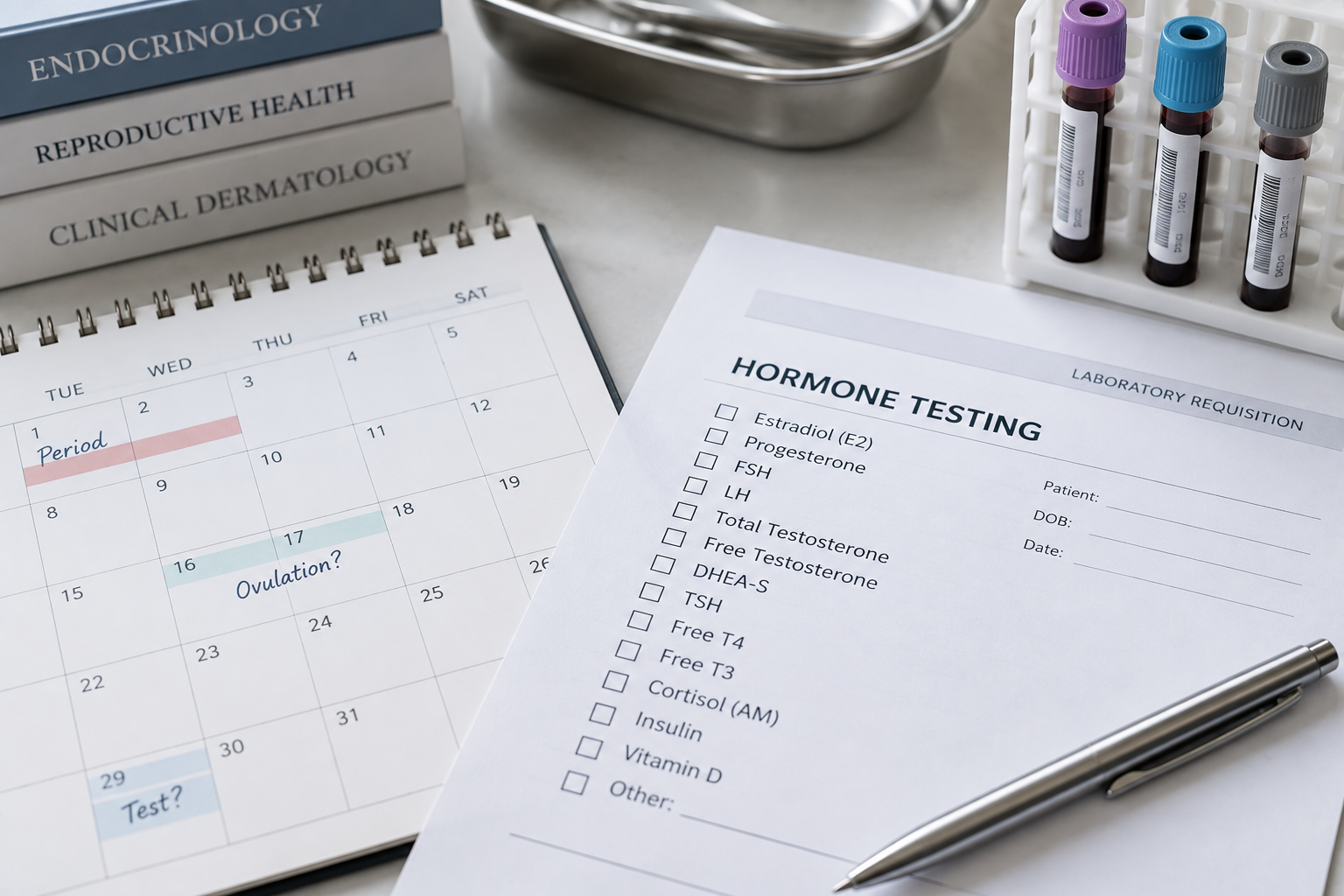
I find hormone testing incredibly valuable. I use it when I have a specific clinical question, during perimenopause when it may add useful information, and to establish a baseline even when hormones aren’t the primary focus of our work.
The important distinction is that a hormone result gives us information. It doesn’t necessarily give us the entire explanation.
For example, progesterone testing. You may have heard that progesterone should be checked on day 21 of your menstrual cycle. That timing assumes a 28-day cycle with ovulation occurring around day 14.
Progesterone rises after ovulation and typically reaches its highest levels around the middle of the luteal phase. When we're using progesterone testing to help confirm ovulation and better understand progesterone production, timing matters.
For women with shorter, longer, or irregular cycles, testing automatically on day 21 may miss this window and provide misleading information. If testing occurs before ovulation, progesterone will naturally be low because it hasn't risen yet. Without considering where someone is in their cycle, that result could be misinterpreted as a progesterone deficiency, potentially leading to unnecessary concern or interventions.
This is why I prefer to time testing approximately seven days after suspected ovulation, or about one week before the next expected period, rather than relying on a specific cycle day.
Perimenopause gives us another example.
Hormone levels can fluctuate considerably during the menopause transition. That doesn’t make testing unhelpful. It means we need to understand what a result can and cannot tell us.
A measurement gives us a snapshot of hormone levels at that point in time. It may provide valuable information or a useful baseline, while still missing fluctuations occurring across days or weeks. And the number itself doesn’t tell us how sensitive an individual woman may be to those hormonal changes.
Two women can have similar laboratory values and very different experiences. That is one reason I interpret testing alongside symptoms, menstrual changes, health history, and life stage rather than asking the lab result to tell the whole story.
More Hormone Testing Doesn’t Always Mean More Answers
I don’t think the answer is less hormone testing. I think it is more thoughtful hormone testing.
Sometimes a hormone level gives us an important piece of information, and other times it establishes a baseline we can refer back to later. It can also help us identify a pattern, support a clinical suspicion, or point us toward something that deserves a closer look.
At the same time, normal hormonal fluctuation, test timing, medications, and life stage all influence how we interpret the result.
The question I want to answer is what this particular result tells us about this particular person.
That makes testing part of the investigation rather than the investigation itself.
What About Normal Versus Optimal Hormone Levels?
There has also been a growing conversation in wellness medicine about the difference between normal lab values and optimal ones.
There can be value in looking beyond whether a result has simply been flagged high or low. Reference ranges have limitations, and symptoms still deserve attention when standard laboratory results appear unremarkable.
But replacing “normal” with “optimal” doesn’t solve the larger problem.
Hormone results aren’t interpreted against one universal optimal number for every woman. The significance of a result can depend on the hormone being measured, why it was tested, cycle timing, age, menopausal status, medications, and other clinical information.
It also depends on the person living in the body attached to that lab report.
A target number can look reassuringly concrete.
The body tends to be less tidy.
What Can You Track Before Your Appointment?
You don’t need to become your own endocrinologist before seeing your doctor. A little observation, though, can give us much better information to work with.
For a few weeks or cycles, consider keeping track of:
The first day of each menstrual period and how long your cycles are
Changes in bleeding, spotting or skipped periods
Symptoms that seem to appear at a similar point in your cycle
Skin changes, including when acne tends to flare
Signs of ovulation you already track, if applicable
New medications, supplements or changes in hormonal contraception
Major changes in sleep, stress, digestion, exercise or nutrition that happened around the time your symptoms began
Don’t stress about keeping this perfect. We’re looking for patterns.
Questions Worth Bringing to Your Visit
If you’re concerned about your hormones, these questions can help move the conversation beyond “Are my hormones balanced?”
Could something besides hormones be contributing to these symptoms?
Is there a pattern in my symptoms or cycle that changes what we should investigate?
Would hormone testing be useful in my situation, and what would we hope to learn from it?
Does the timing of the test matter?
Would having a baseline be useful even if we aren’t treating a specific hormone issue right now?
What other systems or health factors should we consider alongside my hormones?
Those are much more interesting questions to me because they help us decide what deserves attention next.
Better Questions Lead to Better Hormone Care
I don’t think we need to ban the phrase “hormone balance.” I’ll probably still use it because most of us understand what it is trying to communicate.
I just don’t want the conversation to stop there.
Your symptoms may involve hormones without being explained entirely by hormones. Your hormone levels may shift because something else in the body is changing. Testing may give us an important piece of the puzzle without giving us every answer.
That broader view is the real takeaway.
If your periods have changed, your skin is suddenly breaking out, you’re struggling to conceive, or you’ve noticed symptoms that make you wonder about your hormones, we can ask much more useful questions.
Bring that information with you. Then we can combine what you’ve noticed with your health history, life stage, physical symptoms, and appropriate testing to decide what deserves a closer look.
And that, to me, is far more useful than chasing a hormonal state no one has clearly defined.
Frequently Asked Questions About Hormone Imbalance
What are common signs of a hormone imbalance in women?
Possible signs of a hormonal condition can include menstrual cycle changes, missed or irregular periods, acne, increased facial or body hair, fertility difficulties, and symptoms associated with perimenopause or menopause. These symptoms can also have other contributors, so their presence doesn’t necessarily mean hormones explain the entire picture.
When is the best time to test female hormones?
It depends on the hormone and the reason for testing. Some reproductive hormones need to be interpreted in relation to the menstrual cycle. Progesterone testing, for example, is ideally timed around seven days after suspected ovulation (7 DPO), when levels are typically near their peak, rather than automatically testing on cycle day 21.
Can my hormone levels be normal even if I have symptoms?
Yes. A result within a laboratory reference range doesn’t automatically explain or dismiss a symptom. The usefulness of a hormone result depends on what was tested, timing, medications, age, life stage, and the clinical question being investigated. Hormone levels also don't necessarily tell us how sensitive your body may be to hormonal fluctuations.
Can hormone testing be useful during perimenopause?
Yes. Hormone testing can provide useful information during perimenopause and menopause, particularly when interpreted alongside symptoms, menstrual cycle changes, age, and health history. Some hormones fluctuate considerably during perimenopause, meaning a single result may provide only a snapshot of what's happening. Other hormones may be more stable, so the value of testing depends on which hormones are being measured and why.
Hormone testing can also be valuable for women using menopausal hormone therapy (MHT). Absorption and hormone levels can vary from person to person, particularly with transdermal preparations such as patches and gels. Testing can help assess the levels being achieved and inform treatment adjustments alongside symptoms and individual health goals.
Wondering What Your Hormones Are Actually Telling You?
If you're dealing with persistent symptoms, menstrual cycle changes, fertility concerns, hormonal acne, or changes that may be related to perimenopause, an individualized evaluation can help you better understand what's going on.
My approach considers your symptoms, health history, life stage, cycle patterns, and appropriate testing to explore what may be contributing to your concerns and help guide your next steps.
Learn more about working with Dr. Jessica Gruber.
This article is for educational and informational purposes only and is not intended as a substitute for professional medical advice, diagnosis, or treatment.
